how to use gem identification tools
-
Turn the analyzer (top) filter so that light is blocked.
The gem should allow light to pass through, it can even be a rough stone. Avoid using opaque gems or those set in a closed setting.
Place the gem on the polarizer (bottom) filter.
Rotate the gemstone by turning the bottom filter or using your tweezers.
If the gem stays dark while rotating, it is isotropic (e.g., Garnet, Spinel).
If it "blinks" between light and dark four times during a full rotation, it is anisotropic (e.g., Beryl, Topaz).
If it remains bright throughout, it is polycrystalline anisotropic (e.g., Jadeite Jade, Chalcedony Quartz).
-
Block the light coming through the polariscope, then place the gem under it.
Use an anisotropic gemstone that allows light to pass through.
Hold the gem with tweezers and slowly move it until you see some iridescent, rainbow-like colors shimmering.
At that spot, gently touch the gemstone with the conoscope, you should see an interference figure appear.
It will be one of three types:
Biaxial / Appears as a wide bowtie or two curved dark bands.
Uniaxial / Looks like a target: concentric circles with a cross in the center.
Bullseye / A quartz-only variation of the uniaxial pattern, featuring a glowing, iridescent center instead of a cross.
-
Use a flat light and a “London” dichroscope.
Choose a colored, anisotropic gemstone that allows light to pass through.
Hold and move both the gem and the dichroscope at different angles, up and down, left and right.
Watch for any color changes between the two half-centered filters of the dichroscope.
If the gemstone shows two distinct colors side by side, it exhibits pleochroism, a phenomenon where the gem displays different colors when viewed from different angles under the same light.
-
The gemstone should be faceted or a cabochon, not rough, as rough stones can scratch the glass surface.
Refractive liquid is toxic, so handle it with care and follow the safety instructions.
Place a tiny drop of refractive liquid on the glass surface.
Clean the gem with a soft cloth and gently place it on top of the drop.
Look through the viewfinder to check the shadow line, it indicates the refractive index (RI).
If the gem is isotropic, you'll see only one consistent value.
If it’s anisotropic, you’ll see two values as you rotate the polarizing filter on the viewfinder.
When this occurs, make a note of the readings. Then, gently rotate the stone about 45 degrees and repeat the process a total of four times.
The lowest RI and the highest RI are the LoRI and HiRI, respectively.
The difference between them is the gem’s birefringence.
When you're done, clean everything thoroughly, wipe the gemstone and the surface of the refractometer.
Bonus tip: If one RI remains steady while the other changes, the stone is uniaxial. If both change, it’s biaxial.
-
This method is suitable for gemstones over 1 carat in weight.
Set up the hydrostatic balance kit on your scale according to the instructions.
You should end up with a setup where a water container is suspended above the scale, but its weight is not registered by the scale. A tray is submerged in the water, and only this tray is weighed by the scale.
The water should sit around or next to the scale, effectively bypassing it.
Make sure the submerged tray isn’t touching anything, and that the support cage rests cleanly and stably on the scale.
Set the scale to carats, and zero it out.
First, weigh the gem in air. Repeat a few times for accuracy.
Then gently place the gem on the tray underwater.
Record the reading and remove the gem.
Repeat this underwater measurement 3–4 times to ensure consistency.
Important tips:
Wipe off any water from the gem and tweezers before each weigh-in.
Watch for air bubbles trapped under the gemstone, they’ll throw off the reading.
Once both weights are consistent, use this formula to calculate specific gravity:
Specific Gravity = Weight in Air ÷ (Weight in Air – Weight in Water)
Gem ID Guide
Want to know what your gem might be?
Take a look at the Gem Identification Guide with refractive index values and key tests to help you figure it out.
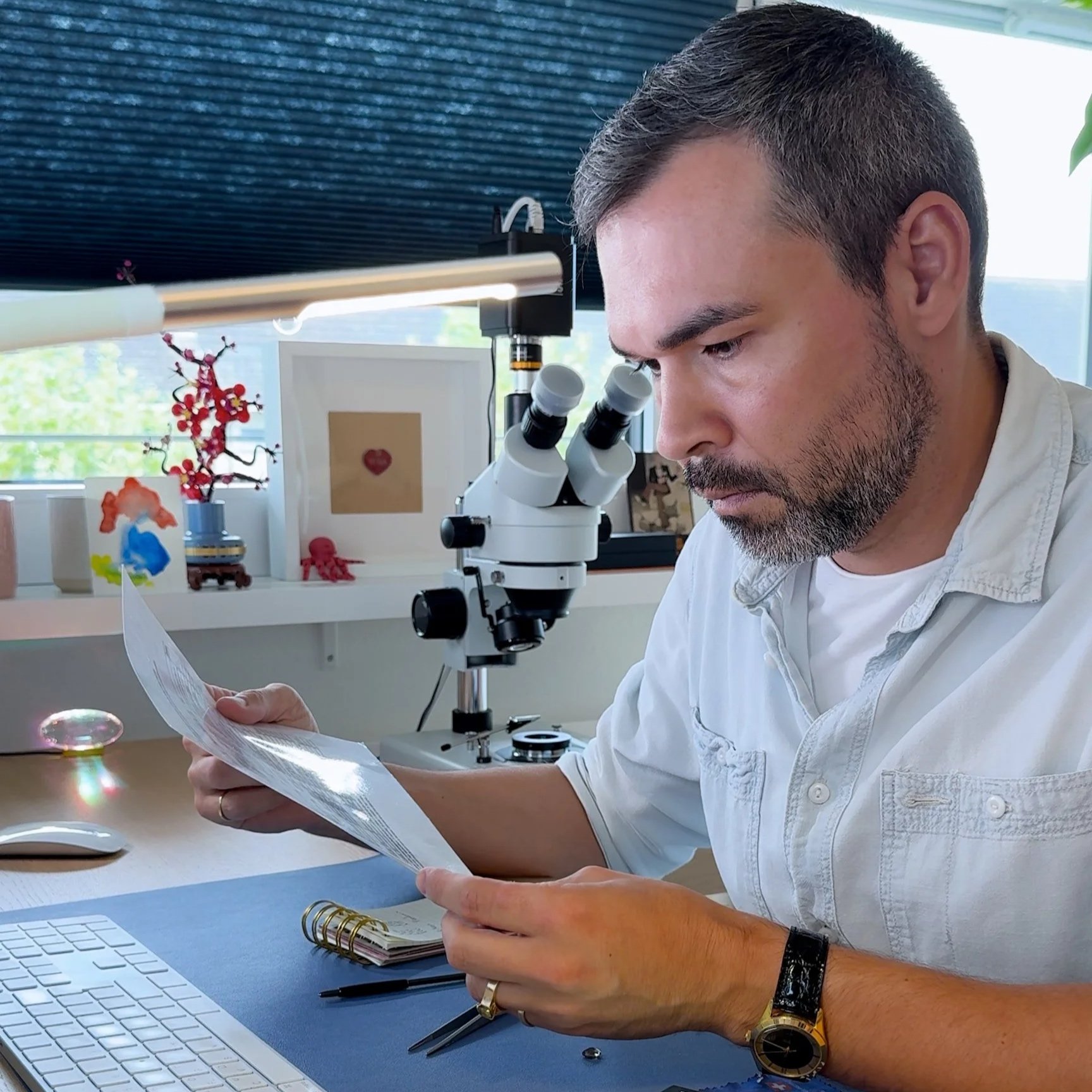
YouTube Tutorials
The gem-lab in detail
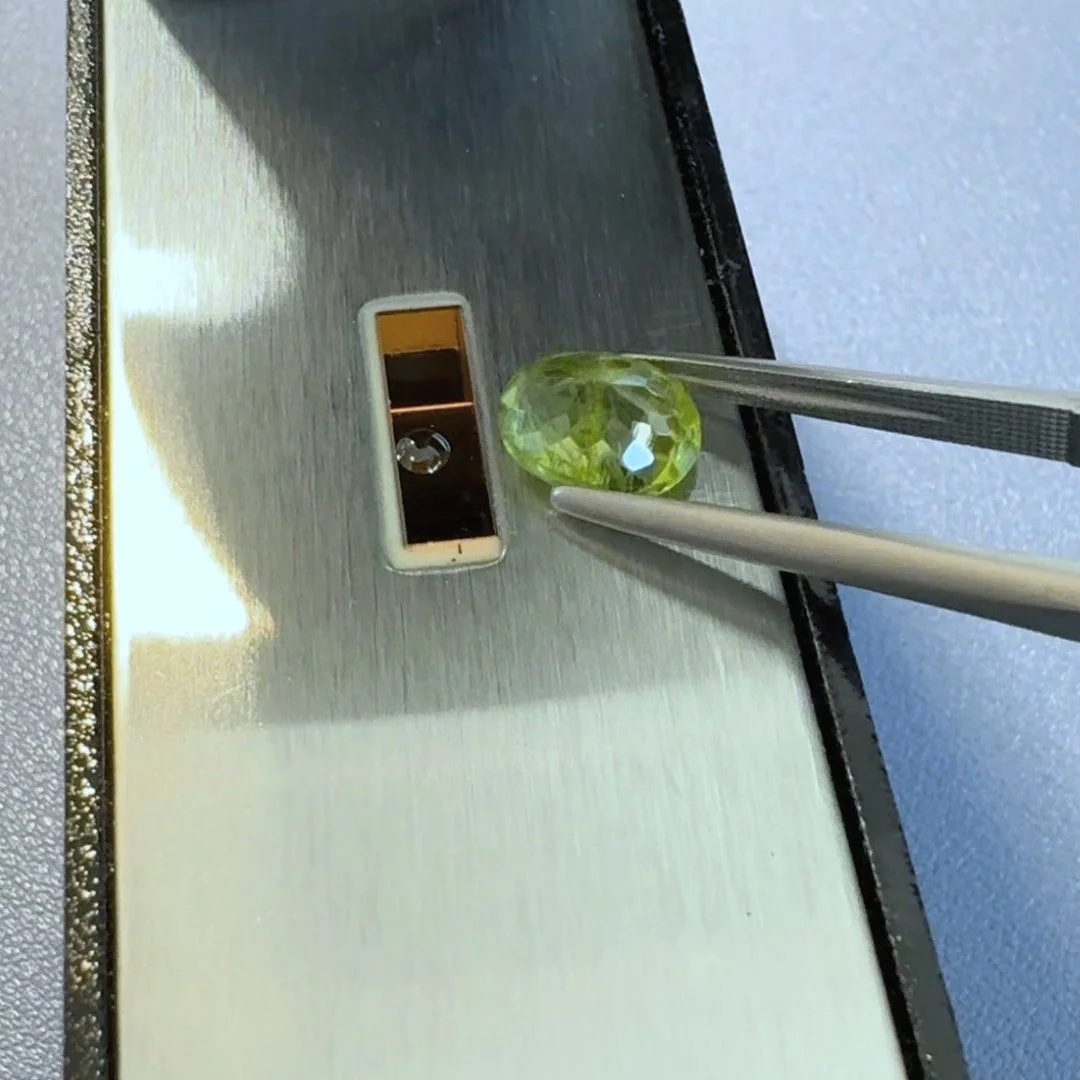
Polariscope
The polariscope is where gem identification begins.
It instantly reveals whether a gemstone is isotropic or anisotropic, displays signs of anomalous double refraction (ADR), or indicates a polycrystalline structure.
This simple test quickly helps narrow down the possibilities of what the gemstone could be.

Conoscope
This little "magic wand" reveals the optic axis of anisotropic gemstones.
It can indicate whether a stone is uniaxial or biaxial, for example, quartz will show a bullseye pattern, confirming it's uniaxial.
This step further narrows down the possibilities in the gem identification process.

Dichroscope
A dichroscope, paired with a flat light source, can instantly detect pleochroism, a phenomenon where a gemstone displays different colors from different angles under the same light.
Only colored, anisotropic gemstones exhibit pleochroism, as light bends and splits into two (or sometimes three) paths as it passes through.
This step sharpens the focus, bringing us closer to identifying the gemstone.

Refractometer
This is where numbers start to play a key role in the gem identification process.
The refractometer measures the refractive index by analyzing how light enters and exits the gemstone.
Handling the refractive liquid requires extra care, as it is hazardous. By this stage, the possibilities have narrowed, and in many cases, the gemstone has likely been identified.This is where numbers start coming in, during the gem identification process.
Hydrostatic balance instrument
This is my favorite step in gem identification, determining a gemstone’s specific gravity.
By weighing the gem in carats both in air and underwater, then doing a bit of math, we can calculate its density.
It’s another precise, measurable result that plays a key role in confidently identifying the gemstone.

Practical gemology handbook, by Gem-A
This book, along with my gem data cheat sheet, is where all the tests come together to definitively identify the gemstone.
I start by cross-referencing every number and observation, then use it to guide me toward specific features to look for, diving deeper into the gem’s story.
I wish I had every detail memorized, but for now, this book is an essential part of my gem lab.

Microscope
What makes my gem lab complete.
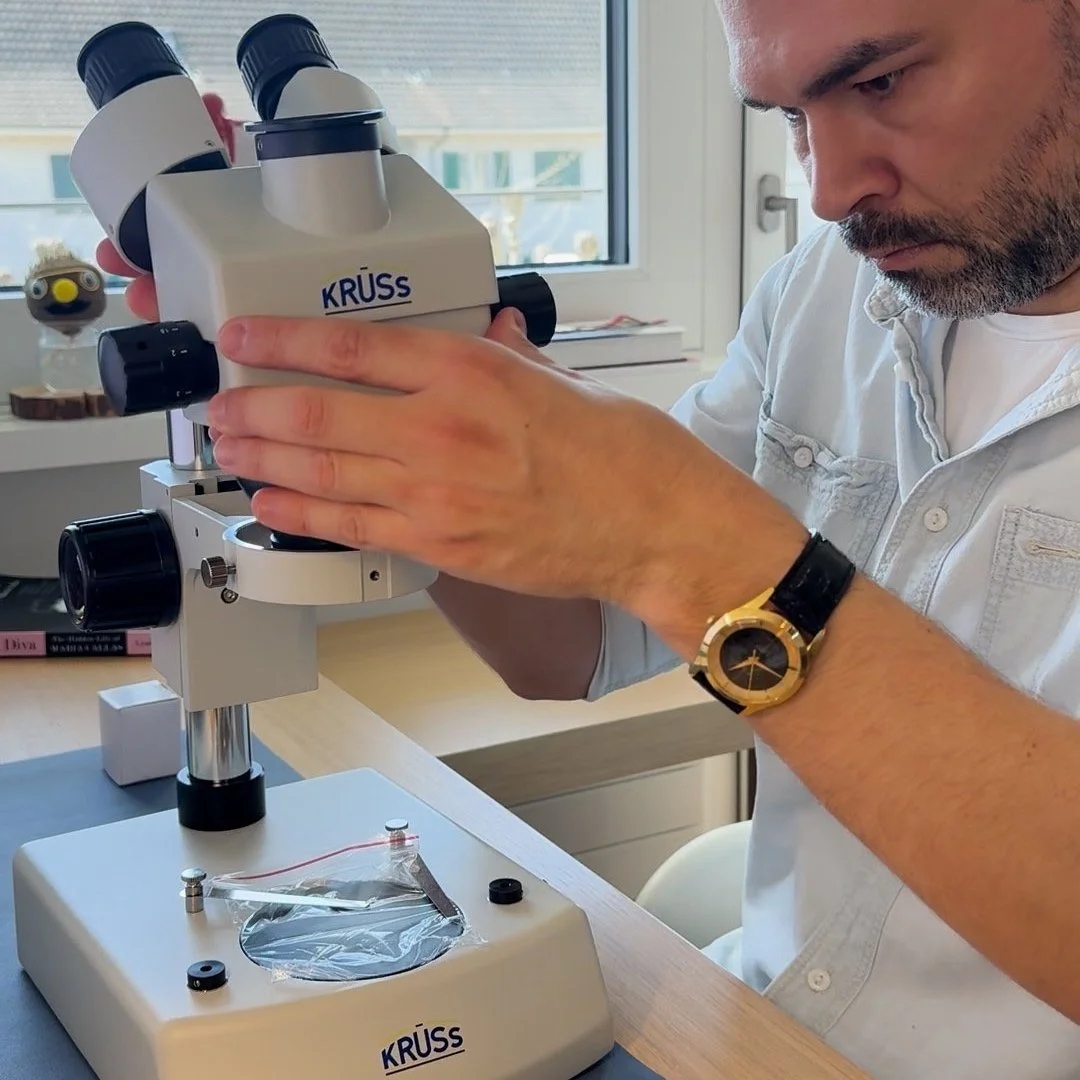
Once gem identification is done, the microscope reveals the stone’s inner world, its inclusions, fractures, fissures, treatments, and signs of lab synthesis.
This is where time disappears, exploring each detail, comparing and cross-referencing with archives of known inclusions. It’s like traveling through the gem itself.
Spectroscope
With my diffraction grating spectroscope, I can now study absorption patterns in gemstones. These patterns provide supporting information during identification, helping to confirm results or reveal details that other instruments might miss.
While it’s not always required in the basic process, the spectroscope is a powerful tool that adds depth and precision to gem analysis.

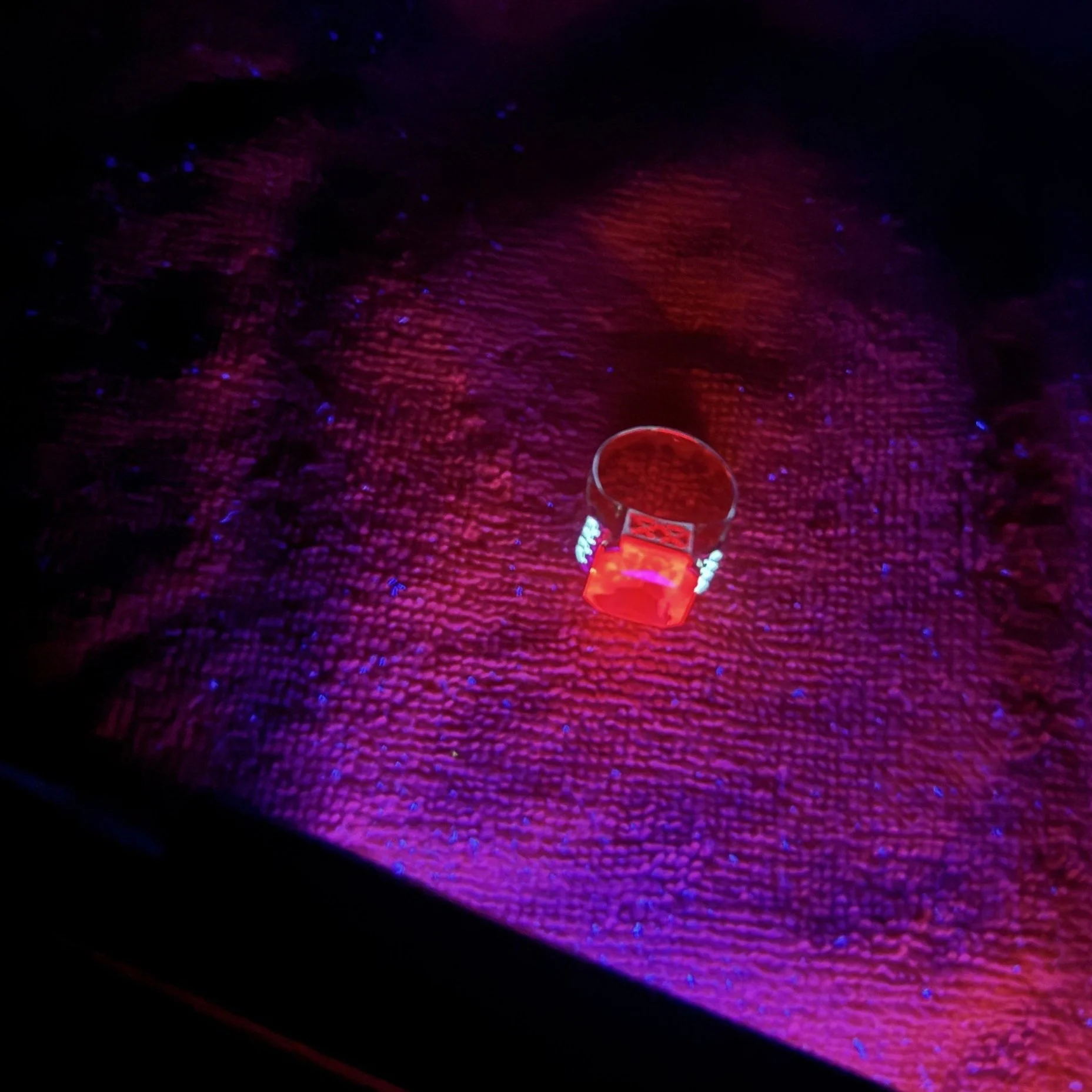
UV torch
Ultraviolet light can reveal valuable information about a gemstone, especially when checking for treatments or signs of synthetic origin.
Both longwave and shortwave UV are used to observe possible reactions and uncover features invisible to the naked eye.
Not every gem requires this step, but for some, it's absolutely essential.
Chelsea Filter
The Chelsea filter is a simple but effective tool. By viewing a gemstone through it under strong light, certain colors may shift or stand out, sometimes appearing red or green.
It’s not a definitive test on its own, but it can give quick clues about whether a gem might be natural, treated, or synthetic.

How to use testing instruments at home
@what_the_gem What is a conoscope? What is the optic figure? Terminology like uniaxial, biaxial, anisotropic, bullseye, interference figure, is used frequently and is key to identifying gemstones. #conoscope #hobbylab #gemologist #gemology #hobby #gemidentification #gem #gemstones #gems #gemstone #cutgems #gemtok #facetedgems #gemstoneslovers #fyp ♬ Waltz No. 10 / Chopin , Piano(1085818) - Noi m knot
@what_the_gem Terminology session: Polariscope, optic character, isotropic, anisotropic, anomalous double refraction (ADR), polycrystalline anisotropic. What do they mean? #polariscope #hobbylab #gemologist #gemology #hobby #gemidentification #gem #gemstones #gems #gemstone #cutgems #gemtok #facetedgems #gemstoneslovers #fyp #gemstonecarving ♬ Bach balance rhythm clavier No. 1 piano performance - moshimo sound design
@what_the_gem Refractometer, refractive index, uniaxial, biaxial, isotopic, anisotropic.. you guys might need more info. Here is an explanation of some basics around these terms. Enjoy. 😉 #refractometer #refractiveindex #hobbylab #gemologist #gemology #hobby #gemidentification #gem #gemstones #gems #gemstone #cutgems #gemtok #facetedgems #gemstoneslovers #fyp #gemstonecarving ♬ Calm Music Background (Live) - Zen music
@what_the_gem Dichroscope and pleochroism. Very useful tool an very cool phenomenon. Easy to test and shows very critical information about the gem. As most gems are anisotropic this handy on-the-go test can instantly reveal the gem’s optic character. #dichroscope #pleochroism #hobbylab #gemologist #gemology #hobby #gemidentification #gem #gemstones #gems #gemstone #cutgems #gemtok #facetedgems #gemstoneslovers #fyp #gemstonecarving ♬ Piano music(806606) - Draganov89
@what_the_gem Hydrostatic Balance Instrument and specific gravity! Sounds complicated, right? But it is not as scary as you might think. It is a simple way to get some numbers during gem identification. #specificgravity #hydrostaticbalance #hobbylab #gemologist #gemology #hobby #gemidentification #gem #gemstones #gems #gemstone #cutgems #gemtok #facetedgems #gemstoneslovers #fyp #gemstonecarving ♬ Sentimental Piano - DJ BAI